 Skip-the-line available
 The Best Time to Visit the Moorish Castle in Sintra
A month-by-month guide to weather, mist, light and crowds on the Sintra ridge — and why the Castelo dos Mouros rewards a different itinerary slot than Pena Palace.
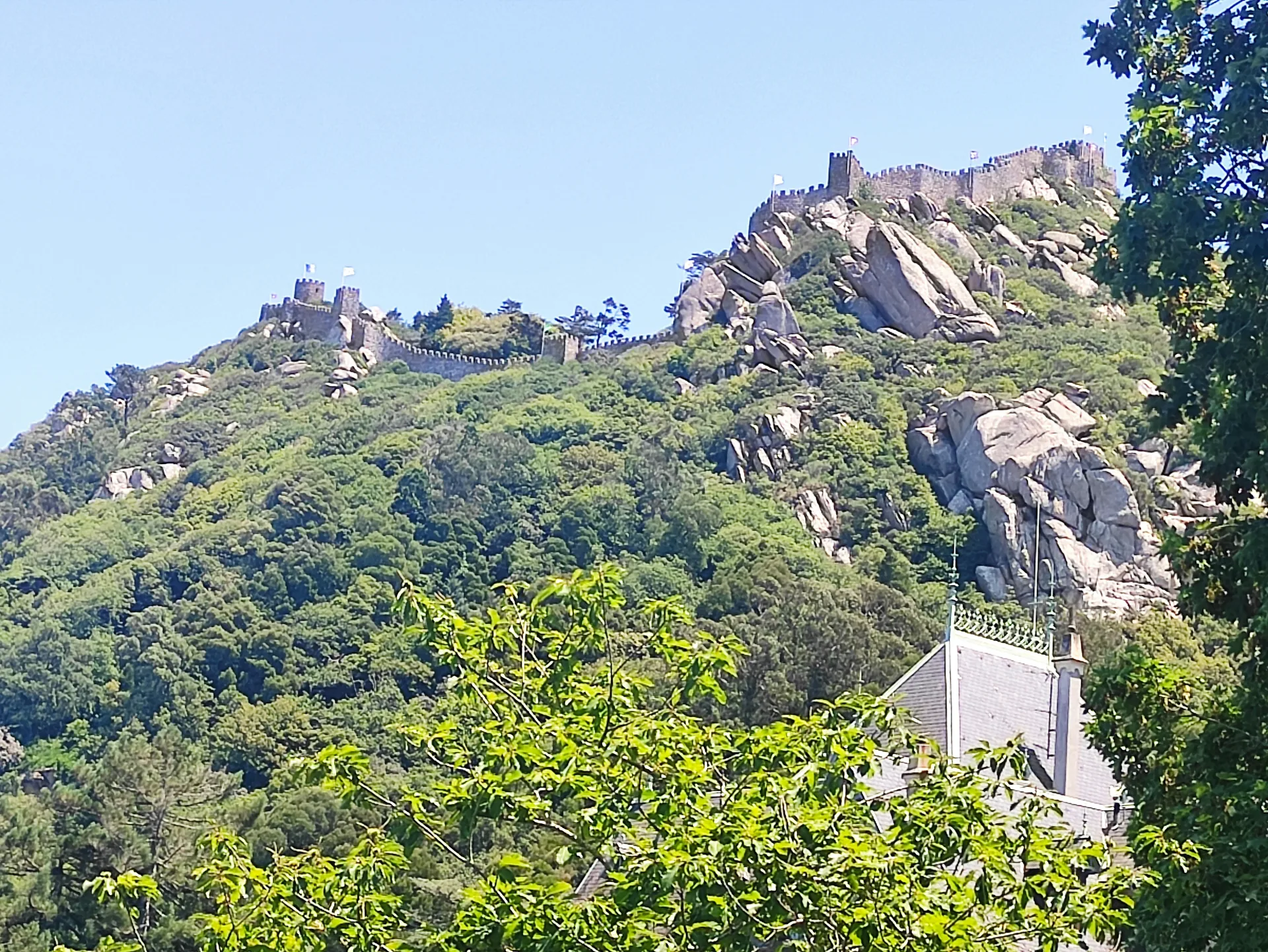
The Castelo dos Mouros is an outdoor monument — a kilometre of restored battlements draped along a granite ridge at roughly 471 metres above sea level. That single fact decides everything about when to visit. Unlike Pena Palace next door, which is a roofed museum largely unaffected by weather, the Moorish Castle is wholly exposed to the Sintra microclimate: cooler than Lisbon, wetter than Lisbon, and prone to dense Atlantic mist that can reduce the Royal Tower view to a white wall. The operator, Parques de Sintra-Monte da Lua (PSML), opens the gates daily at 09:30 with last entry strictly enforced at 17:30. Within that window the experience swings dramatically by month, by day of week, and by the two-hour slot you arrive in. This guide breaks down the Sintra calendar, the weekly rhythm of visitor flows, and the light conditions that decide whether your Royal Tower photograph is the postcard or a featureless cloud.
The Sintra Microclimate Above 400 Metres
The Serra de Sintra rises abruptly from the Atlantic coastal plain to peaks just over 500 metres, and the prevailing westerly winds force moist Atlantic air upwards as it crosses the ridge, condensing it into orographic cloud and rain. The practical result is that the Moorish Castle is reliably three to six degrees Celsius cooler than Lisbon thirty kilometres south, and noticeably cooler again than Sintra town two hundred metres below. Annual rainfall on the Serra is roughly double that of central Lisbon. The Portuguese word for the local mist is nevoeiro; it forms within minutes when warm air rises over the ridge, and at castle elevation it can sit thick while the town below remains in clear sunshine.
Mist behaves differently across the seasons. From November to March the nevoeiro often settles in at sunrise and lingers into the afternoon, sometimes obscuring the battlements for entire days. From April to September it is more episodic — common at dawn, usually clearing by mid-to-late morning, and occasionally returning toward dusk. Lord Byron, who visited in 1809, called Sintra a glorious Eden precisely because of this contrast with the dry Lisbon plain. For visitors planning a Royal Tower photograph the implication is direct: a Lisbon weather app is not a Sintra weather app, and a flexible-date booking is worth more than the discount on a single fixed slot.
Month-by-Month: What to Expect Across the Year
January and February are the quietest months on the ridge. Visitor numbers are at their lowest, the bus 434 queue at Sintra station rarely exceeds ten minutes, and you can walk the full rampart circuit without queueing at any of the towers. The trade-off is the weather: short days, frequent mist, and a higher chance the Royal Tower view will be reduced to white cloud. March is a transition month — days lengthen, the Serra's planted exotics green up, and Lisbon weekend day-trippers begin returning, though weekday mornings remain calm. The Santa Maria trail from Sintra town up to the castle is at its most photogenic in early spring as camellias peak in the surrounding woodland.
April through June is the strongest combination of weather, light and atmosphere. Temperatures are mild, mist is more theatrical than obstructive, and the granite walls take warmth into the late afternoon. July and August deliver the most reliably clear Royal Tower views, but the ramparts are fully exposed to direct sun, the wall-top stones radiate heat, and the bus 434 morning queue at the station can exceed thirty minutes between 10:00 and noon. September is the strongest shoulder month — warm, dry, with crowd levels easing from mid-month. October through December gradually return to off-season conditions, with November producing the most atmospheric photography if you accept the visibility risk.
The Last-Entry Rule and Why It Decides Your Slot
PSML opens the Castelo dos Mouros at 09:30 daily and closes the gates at 18:00, with last entry strictly enforced at 17:30 — sixty minutes before closing. This is not a soft rule. Staff at the lower gate turn away visitors who arrive in the final hour because the full rampart circuit, including the Royal Tower and a stop at the chapel of São Pedro de Canaferrim, takes 60 to 90 minutes to do properly. The ticket office near the entrance also closes for lunch between 12:00 and 13:00, although automatic ticket machines remain available — concierge customers bypass this entirely as the QR code is sent in advance.
The practical implication is that arrival slots realistically fall into three windows. The 09:30 opening slot puts you on the wall tops before the bus 434 crowds arrive from Pena, and is the calmest interior light at the chapel and the cistern. The early-afternoon window — broadly 13:30 to 15:00 — catches the best exterior light on the Royal Tower with Pena visible across the saddle. The 16:00 to 17:00 window benefits from groups already having descended, but cuts the rampart walk close to last-entry cutoff for slower visitors. Mid-morning, between 10:30 and noon, sits inside the densest crowd window and is the slot to avoid.
Weekly Rhythm: The Quietest and Busiest Days
The Moorish Castle's visitor flow tracks Sintra's overall pattern closely. Saturdays and Tuesdays are the two busiest days. Saturdays bring Lisbon residents on local day trips together with international weekend visitors; Tuesdays absorb a cross-section of cruise-ship arrivals from Lisbon's terminals plus organised tour-bus itineraries that prioritise Tuesday departures. Sundays are second-tier busy. Wednesdays, Thursdays and Fridays are noticeably calmer, and Mondays sit in between — many Lisbon museums close on Mondays which redirects visitors toward Sintra, but the castle remains less pressured than a weekend day.
If your schedule allows only weekend access, choose Sunday morning over Saturday morning — the ramparts are appreciably less congested before 11:00. With full flexibility, a Wednesday or Thursday outside Portuguese school holidays delivers the calmest experience. Portuguese school holidays — the Easter break, the long summer period from mid-June to mid-September, and the Christmas-New-Year window — substantially raise weekday numbers. The Sintra municipal holiday on the twenty-ninth of June draws regional visitors to the town centre, but the castle itself runs on normal entry rules; an early slot clears the ramparts before that day's peak.
Light and Photography Windows on the Ridge
Photography at the Moorish Castle is dominated by one composition: the view from the Royal Tower across the saddle to Pena Palace on the next peak. That image is light-dependent in a way most visitors underestimate. Pena's polychrome facade — yellow tower, red Manueline-revival wing — faces broadly east-south-east, which means it is fully lit from mid-morning to roughly 13:00. By mid-afternoon Pena begins to back-light and the photograph flattens. Visitors prioritising the Pena shot should arrive at castle opening and walk the ramparts directly to the Royal Tower before the bus 434 crowds reach the top.
The castle itself photographs differently. The 19th-century crenellations and the Royal Tower take direct light from the south through the afternoon, with the granite stone warming into a deep ochre an hour before sunset. From the High Cross viewpoint above the castle, on clear days the Atlantic horizon and Cabo da Roca are visible to the west. Sunrise visits are possible only from the surrounding park exterior, as gate access begins at 09:30. PSML prohibits drones across its entire Sintra estate, and tripods, while not formally banned, are awkward on the narrow wall-top walkway and at the small Royal Tower platform.
Frequently asked
What is the absolute best month to visit the Moorish Castle?
May and September deliver the strongest combination of mild temperatures, manageable crowds and clear visibility from the Royal Tower. April and June are close behind. July and August offer the most reliable blue-sky photography but the ramparts get genuinely hot and crowded between 11:00 and 15:00.
Is the castle worth visiting on a misty or rainy day?
Light mist is atmospheric and the lower areas — the chapel of São Pedro de Canaferrim, the interpretation centre, the archaeological village — remain accessible. Heavy rain makes the polished granite stairs dangerous and PSML staff may close the wall-top route on safety grounds. In dense nevoeiro the Royal Tower view reduces to a white wall.
How early should I book my entry slot in summer?
In July and August the 09:30 opening slot and the 16:00 slot are the most desirable and often claimed three to five days in advance. Booking at least a week ahead is sensible for peak season; for off-season visits, two to three days is usually sufficient. Our concierge holds slot availability as soon as PSML releases it.
Are Tuesdays really busier than Saturdays at the castle?
They are typically comparable, with Tuesday slightly heavier because of cruise-ship and tour-bus scheduling out of Lisbon. The crowd composition differs — Saturdays bring more independent and local visitors, Tuesdays more group traffic — but bus 434 fills at similar rates and the Royal Tower platform congests at the same hour.
When does the famous Sintra mist appear?
Most reliably at sunrise and again toward dusk from October to May. Summer mist tends to clear by mid-morning. It forms when Atlantic air rises against the Serra de Sintra ridge and condenses, and it can develop within minutes. The castle at 471 metres is more affected than the town two hundred metres below.
Is the Moorish Castle ever closed on specific weekdays?
No. PSML operates the castle daily from 09:30 to 18:00 with last entry at 17:30. Christmas Day and New Year's Day are the principal annual closures. Hours can shift slightly for public holidays, severe weather or operator maintenance; we confirm the exact hours for your booked date when we secure the ticket.
Does Sintra Tourist Day on 29 June affect access?
The castle stays open under normal entry rules, but the town centre and bus 434 become noticeably busier. If your visit falls on this date, book the 09:30 opening slot and walk the ramparts before the day's peak reaches the ridge.
How much cooler is the castle compared to Lisbon?
On a typical summer afternoon the ramparts are around four to six degrees Celsius below central Lisbon. In winter the absolute difference is smaller but combined with wind on the exposed wall tops and the granite's slow warming, it feels significantly more pronounced. A light layer is sensible year-round.
Can I catch sunset from the Royal Tower?
Not really. Last entry is 17:30 and the gates close at 18:00, which in winter is well before sunset and in summer is roughly an hour before the light turns. Late-afternoon coastal mist often rolls in as the air cools, obscuring the view. Pena's western terraces are the better golden-hour vantage and align better with operator hours.
Which months have the strongest photography conditions?
May, September and October combine clear light with dramatic skies and excellent ridge visibility. July delivers the most reliable cloudless conditions if you prefer pure blue-sky compositions of the Royal Tower against the Atlantic. November produces the most theatrical mist swirling around the battlements for moodier shots — with the visibility risk acknowledged.